
Best LASIK Surgeon in Mumbai: What to Look For & How to Choose (2026)
Why Choosing the Right LASIK Surgeon Matters More Than Price
Credentials to Verify Before Choosing a LASIK Surgeon
- MS Ophthalmology or DNB Ophthalmology from a recognised Indian institution, these are the baseline medical qualifications
- Fellowship in Cornea and Refractive Surgery (FICO, FAGE, or equivalent), this indicates subspecialty training specifically in LASIK and corneal procedures
- FRCS (Fellow of the Royal College of Surgeons) or equivalent international fellowship, relevant if the surgeon trained abroad
- Membership in recognised bodies: All India Ophthalmological Society (AIOS), International Society of Refractive Surgery (ISRS), European Society of Cataract and Refractive Surgeons (ESCRS)
- Documented case volume, ask how many LASIK procedures the surgeon performs monthly. Experienced Mumbai refractive surgeons typically perform hundreds of cases per month
- Peer recognition, publications, teaching appointments, conference faculty roles are indirect signals of clinical standing
Technology Matters: What Equipment to Ask About
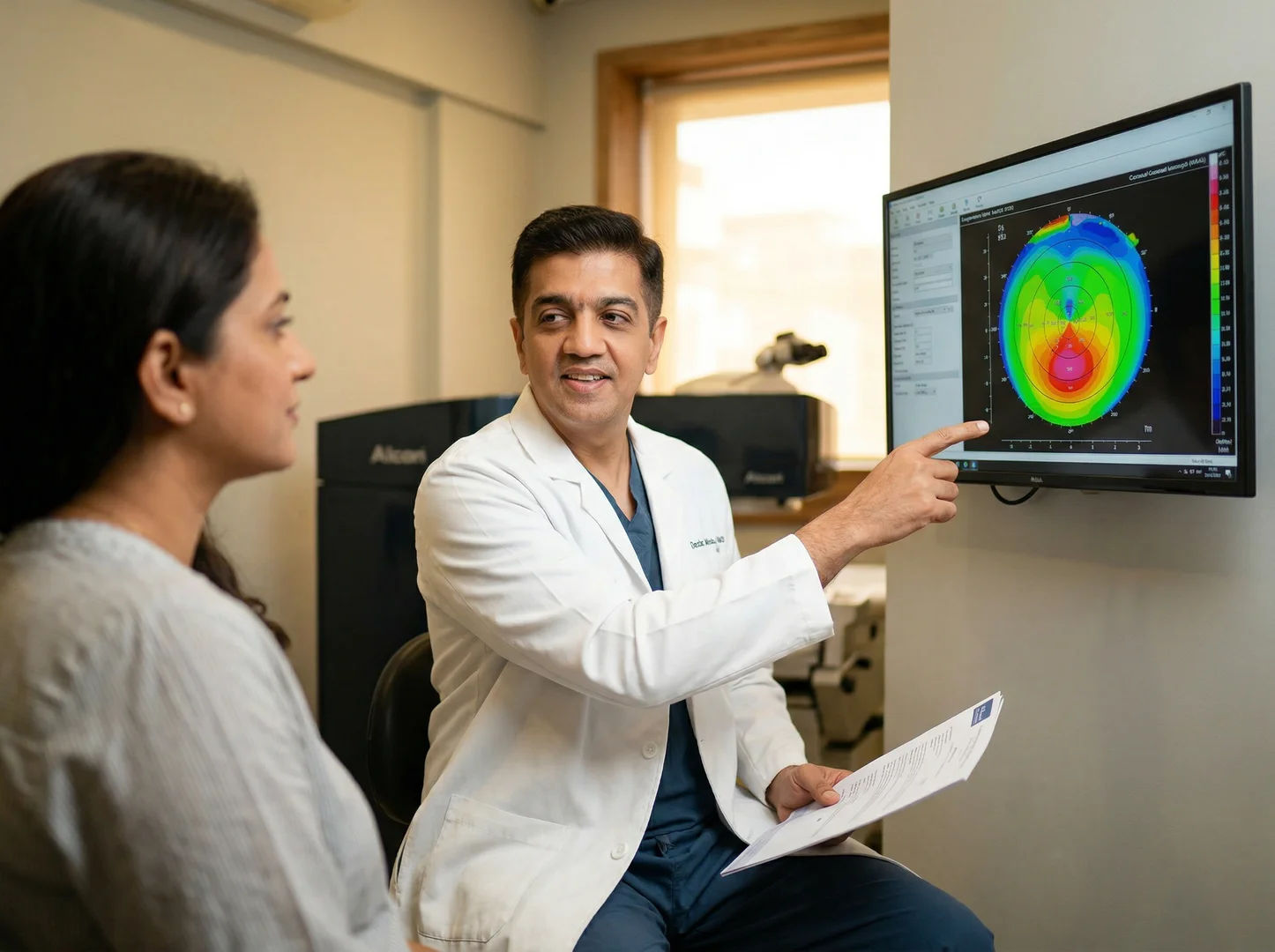
- Corneal topography and tomography system, Pentacam, Scheimpflug imaging, or equivalent (not just keratometry)
- Wavefront aberrometry, measures higher-order aberrations that basic tests miss; essential for customised treatments
- Pachymetry, accurate corneal thickness measurement to confirm safe residual stromal bed after surgery
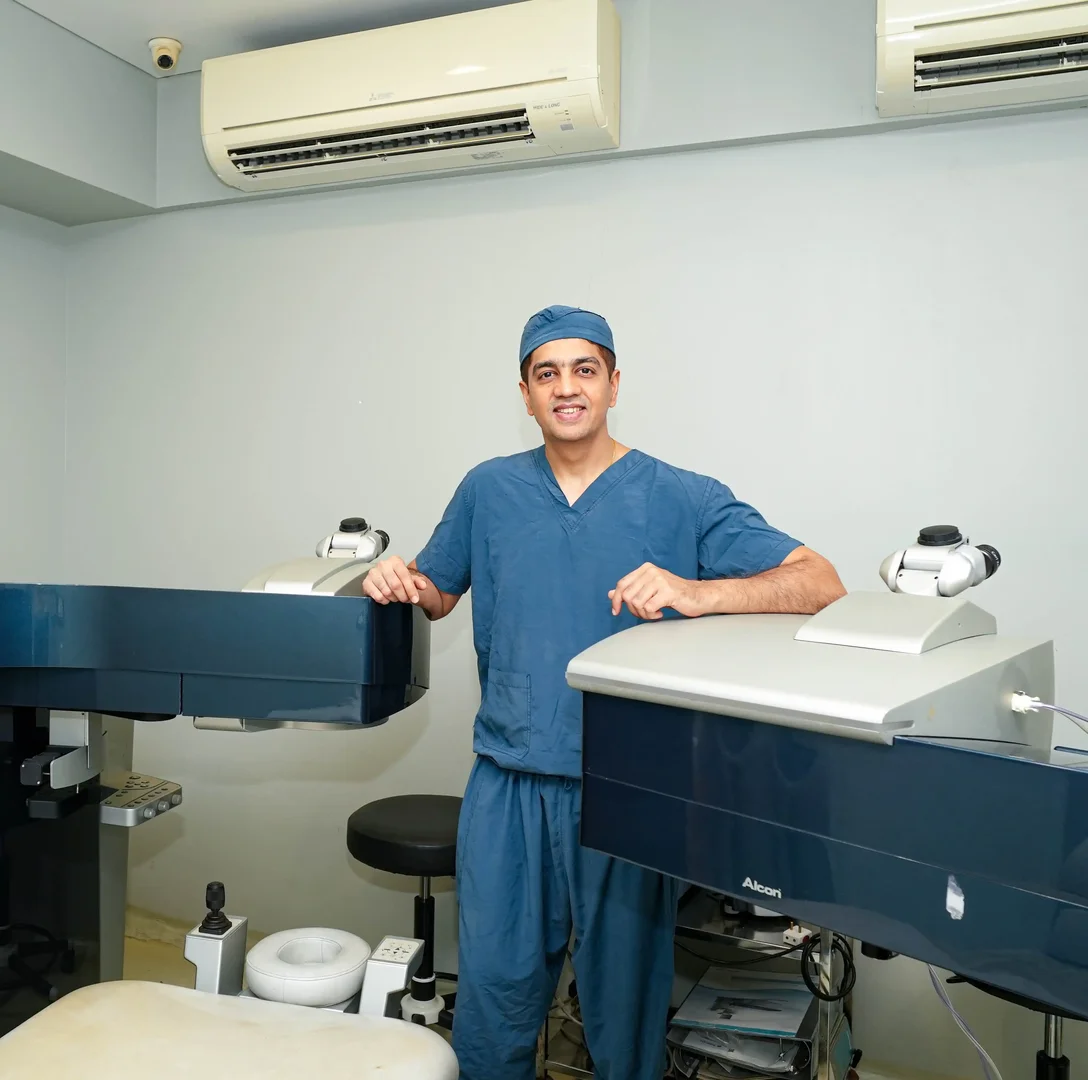
- Femtosecond laser for flap creation, specifying the platform (Alcon WaveLight FS200, Johnson & Johnson iFS, etc.) indicates the clinic is not using generic descriptions
- Excimer laser for corneal reshaping, key platforms include Alcon WaveLight EX500, Schwind Amaris, VISX Star S4
- SMILE or SILK platform, for flapless procedures: VisuMax 800, Schwind Atos, or equivalent
- Dry eye diagnostics, LipiScan, meibography, tear osmolarity testing: essential for high-risk assessment
The Consultation Checklist: Questions to Ask Your Surgeon
- What specific diagnostic tests will be done today, and which ones should be done before surgery?
- What procedure are you recommending for me, and why specifically?
- Am I a borderline candidate for anything? Are there any values in my test results that concern you?
- What is the residual stromal bed thickness after the planned ablation, and how does that compare to the safe minimum?
- What is your enhancement policy if my vision is not where we want it after healing?
- How many LASIK procedures have you performed, and what is your enhancement rate?
- What laser platforms are you using today, and when were they last serviced or updated?
- What happens if I develop a complication? Who manages it, and how quickly?
- Is there anything in my lifestyle, medications, or medical history that changes your recommendation?
- Can I have the full diagnostic printouts from today's workup?
Red Flags When Choosing a LASIK Centre in Mumbai
- Surgery is scheduled before a complete corneal screening is done; this is a serious shortcut
- The pre-operative consultation is done only by an optometrist with no surgeon involvement
- The clinic cannot name the specific laser platform they use or deflects when asked
- No documented follow-up schedule, asks you to come back 'if there's a problem'
- Pressure to decide on the day, 'this offer is only valid today' is not how ethical medical care works
- No enhancement policy or unwillingness to put the re-treatment terms in writing
- One package for all eyes regardless of power, corneal thickness, or lifestyle
- Unwillingness to share or explain the diagnostic results before you consent
What to Bring to Your LASIK Consultation in Mumbai
- Your most recent spectacle prescription, ideally from the last three to six months
- Contact lens wearing history, when you last wore lenses and for how long daily
- History of any eye surgeries, injuries, or infections
- Any eye drops you are currently using (including over-the-counter artificial tears)
- A list of all medications you take systemically, some affect healing or corneal metabolism
- A list of questions (use the checklist above)
- A trusted person to accompany you, post-consultation, your eyes may be dilated and driving may not be ideal
What Makes a Mumbai Refractive Centre Worth Trusting
What a Good Consultation in Mumbai Looks Like
- You spend meaningful time with the surgeon, not just technicians
- Your diagnostic results are explained to you in plain language
- The surgeon asks about your lifestyle, work, and visual goals, not just your prescription
- You are told what you are eligible for and, equally importantly, what you are not
- You leave with a written summary of findings and a recommended plan
- There is no pressure to commit that day
Want our latest updates?
Add iSight Eye Care as a preferred source on Google to see our newest articles in your Top Stories and AI Overviews.
Dr. Nikhil Nasta
Dr. Nikhil Nasta is the Founder & Lead Surgeon at iSight Eye Care. With over two decades of experience, he specializes in advanced cataract surgery and comprehensive eye care, dedicated to restoring vision and improving patients' quality of life.
Related articles
Best LASIK Surgery in Mumbai – Choosing the Right Eye Surgeon
Mumbai offers world-class LASIK and laser eye surgery options—Contoura, SMILE, PRK, and ICL are all available. The best eye doctor in Mumbai is one who matches your eye condition with the safest treatment.
Is LASIK Safe After the Age of 40?
According to Dr. Nikhil Nasta of I-Sight Eye Care, LASIK can be safe after 40, but candidacy depends on eye power stability, corneal health, and dry eye status.
LASIK Surgery in Bandra
If you are searching for LASIK surgery in Bandra, you are not alone. Bandra has become one of Mumbai’s most sought after areas for advanced eye care.
LASIK in Khar & Laser Eye Surgery in Mumbai
Looking for safe and effective LASIK in Khar or laser eye surgery in Mumbai? Here’s everything you need to know about eligibility, cost, procedure, and recovery.
Frequently Asked Questions
Book an appointment with Dr. Nikhil Nasta
Khar & Dadar · NABH accredited
Disclaimer: This information is for educational purposes only. Individual cases vary; consult a specialist for personalized advice.